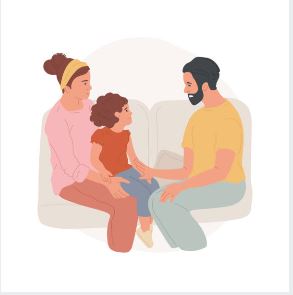
Two thoughtful parents once sat their preschooler down to tell him about their upcoming divorce. Carefully and gently, they told him that Mommy and Daddy were going to stop living together and would now live in different houses, but he would still see both of them regularly. They finished with the most important point of all, that Mom and Dad both still loved him, and asked if he had any questions. The four-year-old was silent. Then he said, "Who's going to look after me?" This little story, related by California psychologist, mediator and author Joan B. Kelly, provides a window into the differences between adult and child experiences of divorce. These parents had done all the right things. They'd sought professional advice and tried to give their son the essential information without overwhelming him. Yet they failed to get across this key point, which may have seemed obvious to them, but wasn't to him. Adults see divorce for the complex, multi-faceted situation it is. Young children tend to view it in concrete and self-centred terms. Big-picture reassurances will mean little to a child who is wondering, "Where will the cat live?" Understanding where kids are at, developmentally, can help you help them adjust to the reality of divorce. How to talk to 0 to 5 year old kids about divorce: Key developmental issues Babies and toddlers • dependence on parents or caregivers • no ability to understand complex events, anticipate future situations or understand their feelings Preschoolers • beginning to develop independence, but still highly dependent • limited ability to understand cause and effect; still unable to think ahead to the future • understanding of the world revolves around themselves • line between fantasy and reality is sometimes fuzzy • some ability to think about feelings, but limited ability to talk about them When Nicholas Benson* and his wife, Lisa, separated last fall, their two children, Andrew, six, and Caitlyn, four, were already accustomed to being with Dad most of the time, since Mom's job kept her out of town all but a few days a month. So when Lisa moved out of their home in Milton, Ont., it took a while for Caitlyn to understand the change. When the kids got home from their first weekend visit with their mother, Caitlyn said, "Mommy home?" even though they had just left her. It will take Caitlyn time and lots of simple explanations before she can understand. What to watch for: Signs of distress in preschoolers include fear, anger or emotional instability, which may be expressed indirectly through clinginess, anxiety, whininess or general irritability. Preschoolers may also lose ground in their development. Tots who were sleeping through the night might start waking up more often, for example. With their limited cognitive ability, three- and four-year-olds can develop inaccurate ideas about the causes and effect of divorce, says Rhonda Freeman, manager of Families in Transition, a program of Toronto's Family Services Association. "If Dad's the one who leaves the home, they might think, ‘Dad left me,' rather than ‘Dad left Mom,'" she says. "Children need to understand that the decision to live apart is an adult decision. It's difficult for preschoolers to understand that." Parental priorities: Consistent care and nurturing give children a sense of stability and reassurance. So as much as possible, tots' lives need to be anchored by their normal routines (meals, play, bath, bed) in the presence of a parent who is "there for them." This, of course, is important to all children, but especially after divorce. As Joan Kelly notes, "If things aren't going well at home, preteens and teenagers can escape by going to hang out with friends. Babies, toddlers and preschoolers can't." Preschoolers need simple, concrete explanations. Stick to the basics: which parent will be moving out, where the child will live, who will look after him and how often he'll see the other parent. Be prepared for questions; provide short answers, then wait to see if there are more. Don't expect one conversation to do the job; plan on several short talks. How to talk to 6 to 11 year old kids about divorce: Key developmental issues 6- to 8-year-olds • a little more ability to think and talk about feelings • broader, less egocentric view of what's going on around them, but still limited understanding of complex circumstances such as divorce • developing more relationships outside the home (friends and school) 9- to 11-year-olds • more developed ability to understand, think and talk about feelings and circumstances related to divorce • relationships outside the family (friends, teachers, coaches) are more developed and become a greater factor in planning the child's time • tend to see things in black and white; may assign blame for split Erica Hallman* of Toronto recalls her daughter Jessica, then in kindergarten, trying to understand the conflicts behind her parents' separation. "One time she asked me, ‘Why are you fighting? Is it because he deleted something from your computer?'" This misunderstanding was easily remedied. Yes, Dad had deleted something from Mom's computer and they had angry words about it, but, of course, that did not cause the divorce. However, her daughter's question made Hallman realize Jessica's need to make sense of circumstances she couldn't fully understand. What to watch for: School-aged children may show their distress as fear, anxiety, anger or sadness, and some display more clear-cut signs of missing their absent parent. Some may have fantasies about reconciliation and wonder what they can do to make that happen. Freeman says, "Children who think that they might be able to bring their parents back together, or that they somehow contributed to the divorce, will have trouble getting on with the healing process. So they need to understand that those are adult decisions which they didn't cause and can't influence." Parental priorities: Stable care and routines are still important. Kids at the upper end of this age range are more able to talk about what they're feeling. However, just because they can doesn't mean they'll want to. Approaching the topic indirectly can help; saying, "Some kids feel sad, afraid or even angry when their parents divorce," is less threatening than asking directly, "Are you feeling sad?" Books about divorce can also help kids focus on their feelings. How to talk to 12 to 14 year old kids about divorce: Key developmental issues • greater capacity to understand issues related to divorce • ability to take part in discussions and ask questions to increase their understanding • beginnings of desire for more independence; questioning of parental authority • relationships outside the family increasingly important Eve Mirowski's* boys were 10 and 12 when she went through a messy divorce from her alcoholic husband. The situation was so bad that, at one point, both parents were ordered by the judge not to discuss the court proceedings. It's impossible to fully shield children from that type of conflict, but Mirowski did what she could. "I just tried to make our home a safe haven…regular mealtimes, regular bedtimes and my husband was never allowed in the house. When I left the boys to go out in the evening, I took my cellphone and told them to call me any time." And call they did, often. Her eldest, Joe, started getting headaches and having trouble sleeping, Mirowski recalls. "I was worried that, given my stress, I couldn't do enough on my own to give him the coping skills, so I got help." Joe started seeing a counsellor who was able to help him enormously. What to watch for: Irritability and anger are common, at both parents or the one who moved out. It can be hard to gauge how much of a young teen's moodiness is related to the divorce. "Think about what your child was like before the separation and how their behaviour or moods have changed," Freeman says. "That gives a clue as to the cause. However, even if you conclude that the problem is not divorce related, that doesn't mean you don't address it." Parental priorities: Keeping communication open decreases the chance that emotional problems slip under the radar. Kids in this age group can be harder to reach, and sometimes they act as if they don't want to be reached. But most teens and preteens still need and crave connection with parents. "Lots of kids have told me, over the years, that they were testing their parents to see if they really cared," Freeman says. So keep talking, even though your child may seem to push you away; make at least some of the conversation about what they want to talk about. *Names changed by request. Surviving the Split Research shows that three factors help children of any age adjust after divorce: having a strong relationship with both parents (when possible and when the child wants it); plain good parenting (what experts call maintaining parenting capacity); and minimal exposure to conflict. No real surprises there. The challenge for parents is pulling it off. Nurturing the bond Loss of a parent-child relationship after divorce can happen when one parent drifts out of the child's life, or when one parent (or both) undermines the other's relationship with the child. Or it may be the child who pulls back, says Rhonda Freeman, manager of Toronto's Families in Transition. "Some children have a temperament that makes it difficult for them to deal with the ongoing hellos, goodbyes and transitions." Parents can't control these factors. What you can do, apart from maintaining your own ties with a child, is to respect his relationship with the other parent. "If you denigrate the other parent in front of your children, you are essentially devaluing their relationship," Freeman says. Good parenting It's hard to maintain normal good parenting when you are grieving a lost relationship and preoccupied with lawyers and court dates. Do your best to keep the adult issues separate from your interactions with your children, and get outside help like counselling if you need it. Both Freeman and psychologist Joan B. Kelly of California recommend divorced parent education classes. "Many parents think, ‘I don't need this,'" Kelly says. "But research shows that separated parents who attend divorce education classes are the most confident." To find classes, check with your local family service agency or information centre, your lawyer or mediator, doctor or counsellor. Containing conflict The ideal approach to post-divorce conflict is to stop it before it starts. Janice Weiss* of Calgary remembers unbearable strife when her own parents split. "I swore my kids wouldn't go through that." She and her ex-husband both agreed to follow the advice in Mom's House, Dad's House by Isolina Ricci. "It became like a bible and it really did help." Here are five ways to lower the temperature when conflict is high: • Limit conversations when exchanging the children. Stick to the basics like confirming pickup and drop-off times. • Don't use children to send messages back and forth with your ex. • Exchange important details in writing. Some parents use email; others use a book that goes back and forth with the children. If things are really tense, have someone else (a counsellor, mediator or friend) screen your email for inflammatory language before you send it. • Respect the other parent's time with the children. Be on time (or have children ready) for pickups. Make sure anything they need to take with them (homework, clothes, special equipment) is ready as well. • Respect your ex-partner's privacy. You have a different relationship now; you're aiming for more of a business-type partnership. You don't need to know as much about his or her personal life as you once did. *Names changed by request. Kids, Your Dad Wants a DivorceShould parents present a united front when telling the kids about divorce?Michele Weiner-Davis, MSW Posted May 11, 2015
No one, especially not parents, takes the decision to divorce lightly. Most people flounder in their marriages for long periods of time and question themselves endlessly before throwing in the towel. The last thing parents want to do is to hurt their children. That’s why when it comes time to break the news to the kids, people want guidelines to help minimize the pain. That’s when they turn to the experts. Most advice is sound - don’t talk about divorce unless you’re certain it’s going to happen, remind the kids the divorce isn’t their fault and that they will be taken care of and loved by both parents, outline the ways in which their lives will change and/or remain the same and don’t burden them unnecessarily with details and so on. However, there is a consensus among professionals about a particular piece of advice with which I vehemently disagree. It goes like this - When breaking the news to the kids, parents should always present a united front. Regardless of the reasons for the divorce, parents are instructed to say that it is a decision made by both of them. Really? The truth is that most divorces in our country are unilateral decisions - one person wants out and the other desperately wants to keep the marriage and family together. In the rare situation where both partners are equally motivated to end their marriage, a united front makes sense. But when two parents are at odds about the viability of their relationship and tell the children that it is a mutual decision, it is a flat-out lie. There are several problems with lying to your children. First, kids are so much smarter than we give them credit for. If they don’t recognize there’s a discrepancy between their parents’ views of divorce at the time the news is announced, eventually, they will. And then they will know that their parents lied, not exactly the world’s best legacy. Parents generally preach the importance of honesty. Research tells us that the axiom, “Actions speak louder than words,” is an accurate description of the way kids actually learn life’s lessons from their parents. They do as we do, not as we say. Furthermore, when they figure out the truth, which they will, they will feel deceived. No one wants that for our children. Secondly, it is frequently the case that the parent who desperately wants to save the marriage places the utmost value on not being a quitter in life, of staying the course even when things aren’t easy. When tough situations arise in their children’s lives, these parents have encouraged them to stick things out despite the fact that dropping out might be easier or more fun. To the parent who prizes stick-to-it-ive-ness, presenting a united front about the dissolution of the marriage defies every bone in his or her body; it’s disingenuous. It just can’t be done. That said, presenting something less than a united front can be tricky. It can lead to a labyrinth of blame and counter-blame. It can tempt the spouse who wants out to justify the choice by explaining the source of unhappiness with the other partner, which is too much information for children. Plus, things can escalate from there. Children may be inclined to take sides or feel the need to be emotional caretakers for the parent who seems sad or angry about the marriage ending. In order to avoid these unfortunate outcomes, how can two people with opposing goals and visions for the future talk to their children about their impending divorce? The fact is, there is no perfect solution to this dilemma. But why not consider the following. Parents could tell their children that they have been fighting a lot lately and disagreeing on many things, including what should happen with their marriage. Nonetheless, since it takes two people to want to make a marriage work, they are going to _____(divorce/separate). There is no need to go into detail about why one person wants out and the other doesn’t. Then, the couple could shift the conversation to emphasize those things about which they do agree - (this is where one inserts what conventional wisdom suggests) - that they love their children, and the children are not to blame for the divorce, and a description of the plan for their future, and so on. Telling the truth to children is by no means a panacea for the pain they will feel about the disruption in their lives due to their parents’ divorce. But it goes a long way to setting a positive precedent for honest and open parent-child communication. William Shakespeare once wrote, “No legacy is so rich as honesty.” 10 Phrases to Use When Talking to Your Kids About Divorce“None of this is your fault”By Anna Barbieri, MD January 28, 2021
|

May 2023 Newsletter
|
By
NM Divorce & Custody Law, LLC





Trusted by Families, Praised by Clients
-
"Tamara was simply amazing, no nonsense and honest! I really appreciate all her help and allowing me to pick her brain, she is a wealth of knowledge and truly has a heart to help others!"- Tiffany FSan Francisco, CA
-
NM Divorce & Custody Law exceeded my expectations in handling my divorce. Tamara and her team are professional, thorough and compassionate. I felt safe, heard and taken care of. Tamara also made sure my kids were heard and their needs were prioritized. We were able to come to a settlement agreement through a successful mediation. The best part of the mediation was my ex and his attorney were in a different room and I never saw them through the whole process! The outcome of the mediation exceeded my expectations and I am so grateful. I highly recommend Tamara and NM Divorce & Custody Law for anyone who is considering divorce. Thank you team!- Christina S.Albuquerque,
-
"Excellent grandparent/child custody guidance."
Bright, mature, highly experienced. Calm and confident.- CF and LOAlbuquerque, NM -
"Very professional"
They were always very professional and very informative.- ShannonDeming, NM